
Entries Tagged 'Islam Religion' ↓

Signifying Eid Milad-Un-Nabi (12th Rabi-Ul-Awwal) From Qur’an And Hadith Perspective

Celebrating in an event of happiness to express joy is quite human. That is why we find almost all religions and cultures of the world with such celebrations, allowing their followers to express and emanate their auspiciousness regarding any particular event. Same is the case with Muslims. Muslim Ummah celebrates a few occasions every year globally, marking their joy and gratefulness to Allah Almighty for endowing them with such blessings.

Eid Milad-un-Nabi (PBUH)

Out of all Islamic months, Rabi-Ul-Awwal holds the honor of being the month when humanity was endowed with the most valuable of all gifts from Almighty Allah, i.e. the birth of Prophet Muhammad (PBUH). This happened more than 1400 years ago when humanity was passing through darkest of its periods. Ever since then, the fate of humanity in general and the fate of followers of Muhammad (PBUH) in particular, had been miraculously turned towards positivity, as emanated from the great teachings of Prophet Muhammad (PBUH). In fact, Allah Almighty reveals to us in the Holy Scripture of Qur’an that:

“We have sent him (Muhammad saw) as a source of mercy for the A’alimeen (humans, jinns and all else that exists),” (Surah 21.Al- Anbiya: Verse 107).

Linguistic experts are of opinion that the word “Milad” is a derivative of “viladat”, meaning birth. It means “Milad” as a word is used to signify the time and place of a particular birth. The whole word as it is mentioned here “Eid Milad-Un-Nabi (PBUH)” signifies of celebration and joy for Muslims in particular and the whole world in general, for getting blessed with the biggest honor from Allah Almighty to them in form of last of the prophets, Muhammad (PBUH).

Milad in relation to Quran

Quran, the Holy Scripture according to which Muslims are to live their lives, also contains content that suggests praising and celebrating the day when prophets (PBUT) of Allah Almighty are born. The following verse of Quran reveals the same as in case of Hazrat Yahya (A.S):

“The peace is on Him the day when he was born and the day when he will die and the day when he will be raised alive.” (Sura Al-Maryam, Verse 15)

This verse mentioned here is in connection with the complete Milad of Allah’s Prophet, Hazrat Yahya (A.S) as mentioned in great detail in the concurrent verses and chapter. Similarly, another narration also exhibits expressions of joy and celebration in relation to the birth of Hazrat Isa (A.S) (or Jesus), also in the same chapter of Qur’an:

“And the same peace on me the day I was born and the day I will die and the day I would be raised alive.”
(Holy Quran, Sura Al Maryam, Verse 33)

Comprehensive Quran Learning leads us to conclusion that Milad of a prophet is deemed as a praiseworthy event by Allah Almighty Himself. Based upon such inferences, it is quite logical to conclude that Eid Milad-Un-Nabi (celebrated on 12th of Rabbi-al-Awwal) should be an exceptional day of celebration for the followers of Allah (SW)’s last prophet Muhammad (PBUH).

Eid Milad-Ul-Nabi (PBUH) in relation to Hadith

Hadith (descriptive narrations from Prophet PBUH) comes second to Quran for every Muslim to take heed from. There are many ahadith that signify the importance of Eid Milad-Un-Nabi, such as:

The one who rejoices on the birth day of the Holy Prophet would not be severely punished and it is hoped that a Muslim who celebrate the Milad un Nabi (Allah’s Grace and Peace be upon him), will not be punished in hell. Imam Bukhari Rahmatullah Alaih narrates that Abu Lahab would be punished lightly in the hell on Monday. Because he rejoiced and freed his handmaid indicating by his finger, when the Prophet of Allah Almighty (Allah’s Grace and Peace be upon him) took birth. So as a reward of happiness on Milad un Nabi (Allah’s Grace and Peace be upon him) he would be given water by his finger. (Saheehul Bukhari Vol. 2, Page 764)

Conclusion

For Muslims, having true faith is incomplete unless they love and respect Prophet Muhammad (PBUH) more than anything else, as evident from the following hadhith as well:

“None of you becomes a believer until I am dearer to him than his children, his parents and all mankind.” (as reported by Bukhari and Muslim)

That alone should serve a reason more than enough to express your joy and happiness for the greatest of gifts from Allah Almighty to humanity as true Muslims; so make the most of it this year as well.

How Muslim Parents Can Offer The Best To Their Children?

Being a true Muslim is very special in so many ways; right from what one believes to what one acts, compounding to a human specimen that ought to be adored by angels as well. However, it is very unfortunate that only a meager percentage of Muslims stand up to what can be referred as a “True Muslim”.

Heading off in the wrong direction

There can be countless reasons for that. Though majority of people might find it quite unlikely (or even uncomfortable!), but the fact remains that we literally start off in a wrong direction. One might wonder how. Well, the reality is that most of us simply take it for granted that like every other aspect of our lives that needs learning and practice for refinement, working upon being a “true Muslim” also pertains to learning and practice, which is seldom taken care of.

Setting the priorities right

For Muslims, adhering to Qur’an and Sunnah interprets as working towards being a true Muslim. Yet again, this is simply overlooked, for our love and care of worldly affairs rather than thinking for the betterment of an eternal life. Comparing to the worldly standards, if parents want their child to become a good doctor or engineer, they arrange for the best of resources and education for them. It is absolutely fine to care for the best interests of your offspring in providing them with the best of worldly support you can as parents. However, as Muslims, it is extremely ignorant not to think of their betterment in perspective of an eternal life as promised by Allah Almighty.

Unfortunately, this is what majority of Muslim parents all around the world are accustomed of doing in present times. They are misled themselves in believing to provide the best of resources to their children in getting the best of this life, while missing out providing the best of what they would need to do well in the eternal life hereafter.

“So whatever you have been given is but (a passing) enjoyment for this worldly life, but that which is with Allah is better and more lasting for those who believe and put their trust in their Lord. And those who avoid the great sins and lewdness, and when they are angry, they forgive. And those who answer the Call of their Lord, and perform the Salah, and who conduct their affairs by mutual consultation, and who spend of what We have bestowed on them.” (Surah Ash-Shura 42:36-38)

Making the most of precious childhood time

Doesn’t it appear strange to you that we scientifically believe that childhood is the best phase to learn and yearn the best for our children by presenting them with the best of resources and learning opportunities for worldly benefits, but we simply overlook doing the same (if not more) when it comes to assist our children for a live that will last till eternity.

For non Muslims, things are different. They see life in a much different manner than Muslims are ought to do, and they set their priorities accordingly. For Muslims, however, despite being honored with the opportunity of understanding life in the manner Allah Almighty (the ultimate Creator) wants them to, not being able to provide for the best to their children is unfortunate. Providing the best of Quran Education to their children should be the top priority of Muslim parents.

Conclusion

Therefore, in order to make sure that we provide our children with the best resources helpful to blossom their life in the world hereafter, devoting time, money and efforts in providing them with the most formidable basis of religious education during their childhood is the best way to deal with it. May Allah Almighty bless every Muslim parent with this honor!

Verdict of Islam on Men Shaking Hands With Non-Mehram Women

One of the major questions asked by most of the Muslims residing in West is that, shaking hands with a non-mehram woman is permissible or not?

The ‘woman’ in the question includes both Muslim and Non-Muslim women. Though the Eastern countries provide far less places and chances, where non-mehram men and woman can shake hands with each other, on contrary survival is not possible without doing so in the western world. Moreover, shaking hands with a non-mehram woman is regarded as a sin in Islam.

As the Hadeeth of Prophet (PBUH) says:

“For one of you to be stabbed in the head with an iron needle is better for him than that he should touch a woman who is not permissible for him”

This Hadeeth shows the extreme disliking of the act of shaking hands or touching a non-mahram woman. Touching a non-mahram woman is a grievous sin, and receiving a fatal stroke of iron pin on head is better than committing this sin.

The Sunnah of the Holy Prophet (PBUH) is in direct compliance with the message of Quran. Therefore, there is not a single chance that Prophet (PBUH) would do what is against the Quran. Umaymah the daughter of Raqeeqah narrates that:

‘The Messenger of Allah (Peace Be Upon Him) said, “I do not shake hands with women”

This is the clear message of Holy Prophet (PBUH) in case you seek answer to your question of shaking hands with non-mehram women. No reply could be as clear as the reply in the above hadeeth.

Now if Prophet (PBUH) did not shake hands with any women, then the next question that arises in mind is, how did he take the bay’ah (pledge) of all the women?

The custom with men was that, Prophet (PBUH) would take the hand of the other person in his hand and then take his pledge of Tauheed and pronounce him a Muslim. However, in case of women, Prophet (PBUH) adopted a different strategy, which did not require physical touch of any sort. As narrated by Aa’isha (May Allah be Pleased with Her):

“He used to accept the women’s oath of allegiance by words only”

Meaning that he did not apply the same custom of taking pledge of men on the women, there was no handshake and no physical contact.

You will find different tafseers of Mufassareen, where they would mention that during the pledge, the Prophet (PBUH) would ask for a vessel of water, and would dip his hands in to it, and then the women would do the same to complete the pledge. Some of the mufassareeen  say that, the Prophet (PBUH) shake hands with woman, with a Qatari Cloak in his hand, and some say that Umar (May Allah be Pleased with Him), would do the hand shake with women on his behalf.

All of these tafaseer are untrue and unauthentic, especially the last one. If you learn Quran, you will know that Prophet (PBUH) was Masoom (infallible), and if the Infallible Prophet (PBUH) could not shake hand with women, then how could Umar (Allah be pleased with him) do so.

Islam is a religion of understanding, so in case of necessity where a woman does not have any other woman to help her, like in medical treatment, removing of tooth, or any eye procedure, then a non-mahram can touch a woman and it would not be considered a sin. Because the act was performed in dire necessity, and there was no other option.

In a nutshell, shaking hands or touching a non-mahram is extremely prohibited in Islam, with no leverage whatsoever. You can only have physical contact with a non-mahram, if he or she is in a medical treatment, and don’t have the option of being taken care by the same gender.

Teachings Of Quran That Can Turn World Into A Better Place To Live

Today, world is literally a flame, fueled by injustices and prejudices being inflicted upon the weaker ones. As a result, those who feel oppressed retort back and the situation becomes even graver, leading world to more plight and misery. The most unfortunate thing is that all the violence and misery of the world is wrongly associated with Islam, a religion that speaks of equality, justice, brotherhood, and respect.

Mainstream world media, however, is being played by forces of evil that thrive on this unrest and injustice, to label Muslims as oppressors and terrorist, while doing all the dirty work themselves for their monetary and other vested interests. The fact of the matter is that Islam is a religion that speaks of equality, justice, tolerance, brotherhood, and peace. With such high moral grounds to its foundations, it cannot be simply held accountable for worldwide atrocities.

To get acquainted with Islamic teachings, nothing serves as a better source other than Quran, the most exalted of Scriptures, descended to Prophet Muhammad (PBUH) for leading humanity out of the darkness and ignorance. Given below are some basic Islamic teachings from Qur’an that constitute the social structure and fabric of an Islamic society, and one thing is for sure, i.e. world can turn into a place of peace, harmony and tranquility following those teachings.

Equality

Islam tells us that all human beings are to be respected and honored, for the fact that all of them are created equal. The division we see in them based on families, tribes, and nations serves only to differentiate them rather than to turn it into a matter of fake pride and ego to suppress the weaker ones. There are clear instructions in Qur’an about that, as mentioned in the following verse as well:

“O mankind, we have created you from a male and a female, and made you into races and tribes, so that you may identify one another. Surely the noblest of you, in Allah‘s sight, is the one who is most pious of you. Surely Allah is All-Knowing, All-Aware. (49:13)

Freedom of Expression

One of the biggest allegations Islam has to face ever since its inception is that it forces people from other religions to turn towards it. This is totally baseless an allegation as it could be, meant only to label Muslims as oppressors unfairly. Quran teaching in this regard shall clear any doubts that Islam favors or resorts to the use of force. In fact, Islam believes in complete freedom of expression and will, as evident from many verses in Quran, for example:

“There is no compulsion in religion.” Qur’an 2:256

And

Everyone is allowed whether to believe or to deny: “Now, whoever so wills may believe and whoever so wills may deny.” (18:29)

Justice and Fair Treatment

In fact, the principles of justice and fairness led many early non-believers to convert to Islam, and this continues even today, though with much lesser frequency and strength. Islam knows that it becomes suffocating and unacceptable for people to live in societies which are devoid of justice and fairness without any prejudice. The following verse should dawn it to people how strict Islam is about prevalence of justice and fairness:

“O you who believe, be upholders of justice – witnesses for Allah, even though against (the interest of) your selves or the parents, and the kinsmen. (4:135)

Conclusion

These are just a few examples of the kind of teachings Islam bestows upon humanity. If people were to follow such morally high principles, world would definitely turn into a better place to live for all of us. Instead of believing in media led blunt lies about Islam, exploring Holy Quran is a much better way to differentiate reality from fabrication.

Treat People With Your Moral Conduct Not By Means Of Your Wealth

Islam given special importance to Moral conduct, it is a way of behaving well with others by showing your nice word and kind manners. When a person asked about the moral conduct, Imam as-Sadiq answered:

“It is to become modest, speak honorable, and meet your brother cheerfully.”

Most of the individuals put effort on their looks and their personality. But the main aim of a person should be to look for the good Moral Conduct. Moral conduct is the base of all the virtues. Ahl-ul-Bayt used varieties of methods for the glorification of moral conduct:

Holy Prophet said:” The best amongst you are the most well-mannered and generous ones who go on intimate terms with people and people go on intimate terms with them, and whose places of residence are frequently trodden on by guests.”

It is also said that “You should be respected, if you want to be lenient and you might be severe, if you want to be disrespected.”

There were many messengers sent by Allah to people but first he developed moral conduct in them, which is a symbol of the virtues of prophet and also the representation of their personalities.

Prophet Muhammad(P.B.U.H) was a perfect example of the moral conduct, as well as other high moral standards. Because of his ideal moralities, he was able to seize the hearts, and deserved the worthily praise of Allah. There are many lessons of Moral Conduct mentioned in the Holy Quran.

Imam Ali described the moralities of Holy Prophet and said:

“He was the most generous, the bravest, the most truthful and the most faithful, and in terms of temper, the most lenient and in terms of association, the most honorable. Anyone seeing him for the very first time is filled with awe, and any one associating with loves him. I have never seen his like before and after him”.

Prophet Muhammad is a great picture of moral conduct; from Quran Learning you can see the story with Koreish. It can be seen that all the people there were against him and showed various sorts of bitterness that made him travel to his hometown. When Allah made him victorious against all these people, the people of Koreish knew that Muhammad will take his revenge. But the Prophet Muhammad (P.B.U.H) said nothing to them, he said: “What do you think I am going to do with you? Only the good, for you are the noble brother and son of a noble brother,’ they answered. The Prophet Muhammad(P.B.U.H) said, “ I will repeat the same wording of my brother Joseph the prophet:(Today, you are not condemned.) Go, you are released.”

Once Imams AL-Hassan and AL-Hussein noticed that an old man was performing the ablution incorrectly. They avoided pointing him out directly, instead they made him the arbiter who should rule most accurate ablution.

Similarly, a dispute once occurred between Mohammad ibn al-Hanafiyya and al-Hussein who conveyed a message to his brother: “ So then, brother! Your and my father is the same. You are not preferred to me and I am not preferred to you in this point. Regarding your mother Fatima the daughter of the Messenger of Allah, if my mother possesses gold that is filling the earth, she will never reach the standing of your mother. If you read this message, you may visit me so that I will please you. You are surely worthier of virtue than I am. Peace and Allah’s grace and blessings be upon you.”

How Can You Make Your Life Worthier With The Help Of Quran Education?

Life is one of the most precious gifts one can ever demand from the Mighty Lord of the universe, i.e. Allah Almighty; Who not only created human beings, but every single particle constituting the whole wide universe we can see and think of.

Especially blessed are the ones who have been honored with the chance of living life as a Muslim, following the principles of life laid by Allah (SWT) Himself, communicated to us through a scripture as exalted as Quran. However, erroneousness of human nature compels many human beings to go astray and follow a lifestyle that not only creates many problems for them in this life, but the life hereafter.

This article describes some of the ways and habits every Muslim should avoid in order to live a life of peace and prosperity, also guaranteeing the accord of Allah Almighty in the eternal world.

Stay away from the company of ill-intentioned people

This is very important. As mentioned earlier, human nature is prone to getting astray easily. In fact, that is why Allah Almighty had been blessing humanity with constant guidance in form of more than one hundred and twenty four thousand messengers who devoted their lives in guiding humanity out of abyss of ignorance. That is why wise people insist that the company a person keeps counts a lot in determining the way one would live their life. Rogue and ill-intentioned people around you serve to inspire and compel you for bad things, leading you away from Quran education and Sunnah principles, as also mentioned in the following verse:

“… real wish is to see that you become a disbeliever, as they have disbelieved, so that you may become exactly like them. So you should not take friends from their ranks unless they immigrate in the way of God…” (Qur’an; 4:89)

Stop looking for help from anyone other than Allah

Being a Muslim, one of the basic requirements is to consider none other than Allah to be the ultimate source of power and strength, seeking help only from Him. However, it is quite unfortunate and disturbing when people resort to sources other than Allah Almighty as their help. Allah (SWT) loves every human being more than anyone else ever could, and listens to the please and prayers of those who resort to Him with full faith. Consider the following verse to get a better understanding on this:

If My servants ask you about Me, I am near. I answer the call of the caller when he calls on Me. They should therefore respond to Me and believe in Me so that hopefully they will be rightly guided.
(Surat al-Baqara: 186)

Stop being ungrateful

For every human being in general, and for Muslims in particular, being ungrateful is the worst thing to do. Instead of asking for more and complaining for little things that you might have missed in life, think about how much you have gotten without even the need of asking from Allah Almighty.

Allah (SWT) says in Quran:

It is He Who has spread out the earth for (His) creatures: Therein is fruit and date-palms, producing spathes (enclosing dates): Also corn with (its) leaves and stalk for fodder and sweet-smelling plants. Then which of the favors of your Lord will ye deny? (Al Rahman 55; verses 10-13)

Conclusion

It is really up to us how happily we want to live our lives. We can either be the cry-babies, whining, crying, and complaining for the little bit of what we do not have; or be the thankful and grateful beings, expressing our gratitude for countless bounties bestowed to us by Allah Almighty.

Is Islam in Favor of Female Education Or Against It?

World has gotten to know so much about “Taliban”, especially after the horrific tragedy referred as 9/11 that served to perish the lives of more than 3000 innocent human beings in the United States of America. Ever since then, world media highlights any news about “Taliban”, a regime that operated in war-torn country of Afghanistan at the time United States of America in particular and the world in general was awestruck with the tragedy of 9/11.

III-intentioned Western Media – Portraying Taliban’s View About Female Education As That Of Islam’s

It is very unfortunate that western media is portraying the atrocities committed by Taliban as that of Islam, making it look like; perhaps Islam is responsible of all the absurdities committed by Taliban and their allies, particularly banning of education for women. Every now and then, media reports highlight torching a school (targeting girls’ educational institutions in particular), or bombing it, or harassing or terrifying school going girls in some other way; unfortunately again, all in the name of Islam, in a stark contrast to the actual teachings of Islam.

Islamic Concept Of Education

In fact, Islam is a religion that flourished because of knowledge; knowledge about oneness of Allah Almighty, and seeking knowledge of everything Allah wants humans to know.

The following verse from Holy Quran serves as a proof enough about the significance of knowledge and learning in Islam

“Are those who have knowledge and those who have no knowledge Alike? Only the men of understanding are mindful.” Al Zumar, 39:9.

Does it seem logical to you that a religion whose Scripture literally serves to encourage people to become knowledgeable, can ask its followers to ban education for women. This assumption goes as absurd as it can be. In fact, it questions the ranks of those who lack in knowledge as compared to the ones who acquire knowledge and apply it to reach the conclusion that there is no might, but Allah (SWT). Knowing about true teachings of Islam is not possible with detailed Quran education, which is why it is held mandatory for every Muslim irrespective of their gender.

Islam’s Viewpoint Regarding Education Of Females

Islam is a religion of logic and reason. Do you think a society as stubborn as Pagan Arabs could have been forcefully converted to a new religion with teachings totally different from what they had been practicing for centuries? It was made possible simply because of educating those people. It is a fact that females constitute the very basis of any society and discouraging them from education is like disregarding the future of your next generations.

The following hadith shall serve as one of the best examples of how significant Prophet Muhammad (PBUH) deemed the education of females:

Manumission of Slaves [46:723] Narrated Abu Musa Al-Ashari: The Prophet said, “He who has a slave-girl and teaches her good manners and improves her education and then manumits and marries her, will get a double reward; and any slave who observes Allah’s right and his master’s right will get a double reward.” (Sahih Bukhari)

This hadith not only informs us about Prophet Muhammad’s (PBUH) view about female education, but also indicate the fact that how he (PBUH) encouraged eradicating the practice of slave keeping that was so dominant in those times.

Conclusion

The fact is that males and females both serve their part in completion of humanity and keeping one half of humanity deprived of the blessings of knowledge is an unjust act, which would be far from Islamic teachings, since Islam does not promote any prejudice against group of humans. So, those sharing the viewpoint of Taliban shall reconsider their standing in perspective of true Islamic teachings.

Deriving The Objectives Of Life From Quran And Sunnah In An Islamic Society

You cannot achieve anything meaningful and significant without setting a fundamental objective in sight. In fact, it is the fundamental objective that motivates and drives a person to achieve any target one sets. This is also a fact that fundamental objectives of different societies of world differ significantly from each other, giving them a unique identity and a unique place in world.

For example, Aristotle, the great Greek philosopher, according to the wisdom of his times regarded the following three elements as the objectives:

  • Beauty
  • Truthfulness
  • Deeds of good

Similarly, being Muslims, we should know what elements are treated as primary objectives from Islamic perspective. They include:

Total submission to Allah Almighty leading to His utter love, respect and adoration:

According to Islam, Allah is the ultimate creator of the universe. In fact, everything present in universe is meant to teach man about the supremacy of Allah Almighty, accounting to complete submission to Allah’s will in the most loving manner.

In the Name of God, the Lord of Grace, the Ever Merciful We have always sent messages (of guidance) as a mercy from your Lord. He alone is the One who hears all and knows all, the Lord of the heavens and the earth and all that is between them, if only you were firm believers. There is no deity other than Him; He gives life and deals death. He is your Lord and the Lord of your earliest ancestors. Yet they remain in doubt, playing about. (Smoke; Al-Dukhan; 44: 5-10)

Understanding oneself as well as the universe:

Allah Almighty has awarded humanity with what all other species and beings lack in the degree and essence, i.e. intelligence and the power of decision. This is because Allah (SWT) wants humans to contemplate on their own being and creation, as well as that of the whole universe. Consider the following verses of Quran for better understanding:

“Behold! In the creation of the heavens and the earth; in the alternation of the night and the day; in the sailing of the ships through the ocean for the benefit of mankind; in the rain which Allah Sends down from the skies, and the life which He gives therewith to an earth that is dead; in the beasts of all kinds that He scatters through the earth; in the change of the winds, and the clouds which they trail like their slaves between the sky and the earth — (Here) indeed are Signs for a people that are wise.” (Surah Al-Baqarah, 2:164)

Following Islamic values:

This also serves to be one of the major objectives from Islamic perspectives. Since Islam not only preaches religious beliefs and practices, but also awards a complete code of life, following Islamic values for living life, for Muslims serves as one of the major objectives of an Islamic society.

For that, Quran education and Sunnah (the life patterns of Muhammad PBUH) serve as the best sources, as told to us by none other than Prophet Muhammad (PBUH):

“I am leaving you two things and you will never go astray as long as you cling to them — they are the Book of Allah and my Sunnah.” [Reported by Al- Haakim - Sahih].

Conclusion

Islam is the only path that leads to Allah Almighty, as communicated by The Mightiest Himself

Aal-e-Imran [3:19] the Religion before Allah is Islam (submission to His will): nor did the People of the Book dissent therefrom except through envy of each other, after knowledge had come to them. But if any deny the Signs of Allah, Allah is swift in calling to account.

Therefore, the best way is to live your life in a manner that pleases the Ultimate Creator, i.e. Allah Almighty. May Allah (SWT) endow to us the will and strength to achieve these objectives.

Exploring The Colors Of Life The Islamic Way

Islam, as a religion, graced humanity some 1400 years ago. Allah Almighty bestowed humanity with the praiseworthy presence of Muhammad (PBUH) as last of His Apostles. Since then, Muhammad (PBUH) serves humanity as the last human guide ever to lead humanity to the ways of Allah Almighty, the sole creator of the universe, aided by the Holy Scripture referred as Quran. In fact, Muslims believe that the life of Muhammad (PBUH) and Quran are the two main pillars supporting the foundations of Islam.

Historically speaking, let alone religiously, Islam is nothing short of a miracle and a revolution, the one that transformed the lives of a society from almost barbaric to the most cultured society of the whole world. Even astonishing is the fact that this revolution took only about two to three decades.

The revolution whose foundations were laid in the period of Muhammad (PBUH) soon became a universal phenomenon stretching its horizons from East to West. This brought in a great cultural diversity to Islam, making it a beholder of truly colorful heritage. Given below is a description of different colors that set the foundations of this multicolor (but unidirectional) religion referred as Islam.

Green – Beholder Of Islamic Sacredness

It is the most revered color as far as Islamic perspective is concerned. In fact, it is referred as the symbol of Islamic religion itself. It is regarded highly in Islam, because Muslims believe it was worn preferably by Prophet Muhammad (PBUH). Additionally, Quran also mentions the color green as a one dear to Allah Almighty as well, as evident from many verses, such as this one:

Al-Kahf [18:31] For them will be Gardens of Eternity; beneath them rivers will flow; they will be adorned therein with bracelets of gold, and they will wear green garments of fine silk and heavy brocade; they will recline therein on raised thrones. How good the recompense! How beautiful a couch to recline on!

Perhaps, that is why we often see dooms of mosques as well as robes of Quran bearing Green color dominantly.

Black – Emanating Holiness

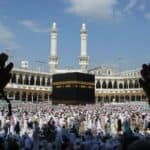
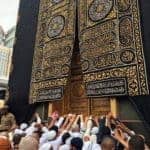
Black is also a symbol of holiness from Islamic point of view. Holy Kaaba, the physical nucleus of all Muslims of the world, a place referred as Allah’s home on earth, is robed in black. Additionally, there is a black stone of high reverence from Islamic perspective, referred ad “Hajr-e-Aswad”, present in Holy Kaaba. Though bowing and worshiping of anything other than Allah is strictly prohibited in Islam, but Muslims feel honored in kissing this black stoned present in Kaaba. By doing so, they associate themselves with the kiss Holy Prophet (PBUH) placed on it while affixing it in a wall in Holy Kaaba.

White – Representative Of Islamic Message Of Peace And Prosperity

The color “White” also bears a special place in Islamic ways of life. It is a representative of the message of universal peace, brotherhood, and harmony that Islam preaches. That is why we see Muslims all over the world wearing white dominantly on the holy day of Friday for observing their prayers.

Blue

Blue color is also known to be associated with Islamic lifestyles in numerous ways. That is why we can see quite dominant presence of Blue in sacred Islamic places, such as mosques and shrines. In fact, there are a lot of Mosques (the prayer house of Muslims) famously painted in blue in countries like Turkey, Afghanistan, Armenia, etc.

Conclusion

Unlike the common perception prevailing about Islam in today’s world, Islam is a beholder of true colors and joys of life. To understand the true Islamic perspective about life and death, one needs to Learn Quran himself rather than being influenced by false propagandas led by media giants with malicious intents.

Hajj – A Religious Obligation Of Great Prospects For Muslims

For Muslims, true success lies in submitting themselves wholly to the wish and will of The Mightiest, living their lives as a means to appease Allah Almighty, following all the obligations of their religion.  The religion for a true Muslim remains insignificant without observing five aspects, referred commonly as “Five Pillars of Islam”. They include

  • Testimony of faith
  • Prayers (Salath)
  • Fasting during the month of Ramadan (Sawm)
  • The Pilgrimage to Makkah (Hajj)
  • Giving charity (Zakat)

In addition to these, equipping one’s self with essential and blessed knowledge of Holy Quran is also deemed as an act of high gratitude towards Allah Almighty. Out of the 5 pillars of Islam mentioned above, testimony of faith is something that a Muslim has to adhere to, every second of their life; while all other pillars are specific to a special time, special place, or both.

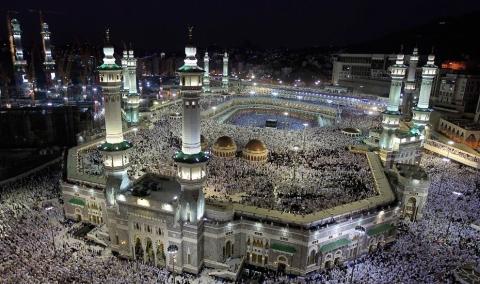
In this article, however, we are going to comprehend on the rituals of “The Pilgrimage to Makkah” or Hajj. Allah Almighty, being the most gracious and the most merciful, though holding Hajj to be an obligation for Muslims, offers great relaxations.

There are specific conditions under which Hajj becomes obligatory to Muslims. If any Muslim fails to fulfill those criteria, the obligation of Hajj is deemed wavered off, as described by Muslim scholars. These include:

Being A Faithful Muslim

Being faithful to Allah Almighty and submitting yourself to Allah’s will completely without any kind of doubt and ambiguity on any of His commandments is primary, not only to all acts of worship (including Hajj), but also to maintain the status of being a Muslim in the first place. Without establishing a clear faith upon The Mightiest and all His commandments, a person is not considered “momin” by Allah Almighty and no act of his worship can gain him Allah’s will.

“And nothing prevents their contributions from being accepted from them except that they disbelieved in Allaah and in His Messenger” [al-Tawbah 9:54]

Holding Soundness Of Mind

No one is more just than Allah Almighty

Al-Anaam [6:62] Then they are returned to Allâh, their Maulâ [True Master (God), the just Lord (to reward them)]. Surely, for Him is the judgment and He is the Swiftest in taking account

Therefore, He does not make it mandatory for a person whose soundness of mind is questionable. Hajj is only mandatory for a Muslim whose mental health and soundness is beyond question.

Being An Adult

Similarly, Hajj is deemed mandatory only for adults (not children) who are grown up and sensible enough to handle different kinds of situations and take care of themselves appropriately. In fact, Holy Prophet Muhammad (PBUH) once said:

The Prophet (peace and blessings of Allaah be upon him) said: “The pen is lifted from three [and does not record their deeds]: from one who is sleeping, until he wakes up; from a child until he reaches puberty, and from one who is insane until he comes to his senses.” Narrated by Abu Dawood, 4403; classed as saheeh by al-Albaani in Saheeh Abi Dawood.

Being Free

Allah has only obligated Hajj on a Muslim who is totally free and not being enslaved (or servant) to someone who might not let his slave to go for Hajj for any possible reason.

In A Position To Do It

Allah Almighty is the most just anyone could ever be, as made clear to us from Quran learning. Therefore, Hajj becomes obligation only to those who are able to do it:

“And Hajj (pilgrimage to Makkah) to the House (Ka‘bah) is a duty that mankind owes to Allaah, those who can afford the expenses (for one’s conveyance, provision and residence)” [Aal ‘Imraan 3:97]

Scholars elaborate that “being able to do it” includes one’s financial as well as mental and physical ability to perform Hajj.

Conclusion

The fact of the matter is that Hajj or “The Pilgrimage to Makkah” is one of the most honored and exalted moments that Allah Almighty bestows to anyone who strives for it. It is such a life-transforming event that no other event or incidence can ever be compared to it. May Allah Almighty honor every single one of faithful Muslims to fulfill this religious obligation promised of countless worldly and heavenly benefits.